Sometimes you need to write a formal message but don’t know who will read it. You might be confirming someone’s employment, submitting a complaint, or asking an organization for information. In those cases, “To Whom It May Concern” can serve as a neutral, professional greeting—but it isn’t always the best choice.
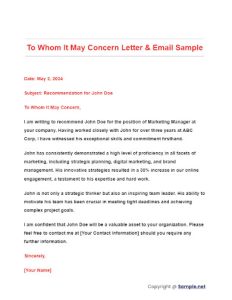 This guide explains when to use the phrase, how to write a letter or email with it, what alternatives to consider, and how to avoid common mistakes.
What Does “To Whom It May Concern” Mean?
“To Whom It May Concern” is a formal, general-purpose salutation. It signals that a message is intended for the appropriate person or department, even if the writer doesn’t know the recipient’s name.
It’s traditionally used at the beginning of letters, often followed by a colon:
To Whom It May Concern:
The phrase is still acceptable in some settings, particularly for documents that may be presented to different readers. But it can sound impersonal, and in everyday business communication, a more specific greeting is usually preferable.
When Should You Use It?
Use “To Whom It May Concern” when:
- You can’t identify the recipient after making a reasonable effort.
- Your letter is intended for an unknown reader, such as a future employer, landlord, or institution.
- You’re preparing a general reference or verification letter that may be shared with multiple organizations.
- You’re writing a formal document that could be filed or circulated without a known individual recipient.
For example, a letter confirming that someone worked at a company may be addressed this way if the employee will present it to different prospective employers.
When Should You Avoid It?
Before using a generic greeting, see whether you can find the right person or department. Check the organization’s website, the original message, or the contact details provided on a form. A named greeting can make your message feel more considered and help direct it to the right person.
Avoid “To Whom It May Concern” when:
- You know the recipient’s name or job title.
- You’re replying to someone who has already contacted you.
- The message is a routine email to a known team.
- You’re making a request that would benefit from being directed to a particular department.
A greeting such as “Dear Hiring Manager,” “Dear Customer Service Team,” or “Dear Dr. Chen” is generally more specific. Purdue OWL’s guidance on professional correspondence emphasizes adapting a letter to its audience and purpose, rather than relying on a one-size-fits-all format.[1]
Better Alternatives to Consider
Try to match your greeting to the information you have:
| Situation | Possible greeting |
|---|---|
| You know the person’s name | Dear Ms. Rivera, or Dear Jordan Lee, |
| You know the person’s role | Dear Hiring Manager, |
| You know the department | Dear Human Resources Team, |
| You’re contacting a company | Dear Customer Service Team, |
| You’re writing to a committee | Dear Admissions Committee, |
| You’re sending a general formal letter | Dear Sir or Madam,—though this can also sound dated |
If you genuinely cannot identify a recipient, “Hello,” or “Greetings,” may work for a less formal email. For a formal letter, “To Whom It May Concern” remains an option.
How to Format the Salutation
For a traditional letter, place the salutation after the recipient’s address and before the body. A colon is common in formal business correspondence:
To Whom It May Concern:
For email, the same wording can be used, though it may feel stiff. If the message is business-casual, “Hello,” followed by a clear subject line may be more natural.
Keep capitalization consistent: capitalize To, Whom, It, May, and Concern. Avoid writing the phrase in all caps.
How to Write the Letter
A strong “To Whom It May Concern” letter should quickly explain why it was written and give the reader the information they need.
1. Use a clear subject or heading
For a letter, include a subject line if it helps the reader understand the document. For example:
Subject: Employment Verification for Alex Morgan
2. State your purpose immediately
In the opening paragraph, identify the person or matter involved and explain why you’re writing.
I am writing to verify that Alex Morgan was employed by Northstar Design as a project coordinator from March 2021 through August 2025.
3. Include only relevant details
Provide the facts needed for the letter’s purpose. Depending on the situation, that might include dates, responsibilities, contact information, or a specific request. Avoid adding sensitive personal information unless it is necessary and appropriate to share.
4. Make the next step clear
If you need the reader to take action, state what you’re requesting and by when. If the letter is informational, explain how the reader can follow up.
5. Close professionally
Use a suitable closing such as “Sincerely,” “Regards,” or “Respectfully,” followed by your name and contact details.
Sample “To Whom It May Concern” Letter
To Whom It May Concern:
I am writing to confirm that Alex Morgan was employed by Northstar Design as a project coordinator from March 2021 through August 2025. In this role, Alex coordinated project schedules, prepared client materials, and supported communication between design and production teams.
This letter is provided at Alex’s request. If you need further information, please contact me at the details below.
Sincerely,
Taylor Reed
Human Resources Manager
Northstar Design
t.reed@example.com
(555) 010-1234
Use this as a starting point, not a form to copy blindly. Adjust the details to reflect the purpose of your letter, and make sure you’re authorized to disclose any information you include.
How to Write a “To Whom It May Concern” Email
Email usually calls for a shorter, more direct approach than a printed letter. Give your message a specific subject line, keep paragraphs brief, and make your request easy to find.
Sample email
Subject: Request for a Copy of My Employment Records
To Whom It May Concern,
I’m writing to ask how I can request a copy of my employment records from Brightpath Media. I worked in the marketing department from June 2022 to September 2024.
Please let me know which form or identification you require and whether I should send the request to a particular department.
Thank you,
Morgan Ellis
(555) 010-4567
For a more conversational email, you could replace the salutation with “Hello,” or address the department directly if you know it.
Common Mistakes to Avoid
- Using the greeting without checking for a recipient. A quick search may reveal a name, role, or department.
- Leaving the purpose unclear. State what the message concerns near the start.
- Writing a long, unfocused introduction. Give the reader the essential context promptly.
- Including unnecessary personal or confidential information. Share only what’s relevant and appropriate.
- Using a generic greeting in an ongoing conversation. Reply to the person or team you’re already communicating with.
- Forgetting to include your contact details. The recipient should know how to respond.
- Treating the phrase as a guarantee of formal correctness. The greeting can be appropriate, but the rest of the message still needs to be accurate, clear, and courteous.
A Quick Checklist
Before sending your letter or email, ask:
- Have I tried to identify the right person or department?
- Does the subject line or opening clearly state the purpose?
- Have I included the information the reader needs—and left out what they don’t?
- Is my request or next step easy to understand?
- Have I checked names, dates, spelling, and contact details?
- Does the tone fit the recipient and situation?
Conclusion
“To Whom It May Concern” is a useful formal greeting when you truly don’t know who will read your message. Still, a named person, job title, or department is often a better choice. Whichever greeting you use, the strongest letters and emails are clear, concise, accurate, and tailored to their purpose.
Sources
- Purdue Online Writing Lab, “Writing the Basic Business Letter,” Purdue University: https://owl.purdue.edu/owl/subject_specific_writing/professional_technical_writing/basic_business_letters/index.html
- Purdue Online Writing Lab, “Email Etiquette,” Purdue University: https://owl.purdue.edu/owl/general_writing/academic_writing/email_etiquette.html