A clear dental bill helps patients understand what they owe, gives insurers the information they need to process claims, and helps a dental practice keep accurate financial records. Whether you run a clinic or need to document treatment for reimbursement, a well-organized dental service bill can make the billing process more transparent and less prone to errors.
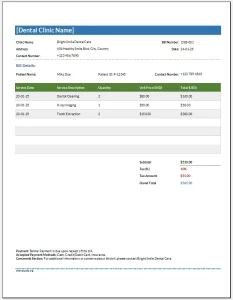 This guide explains what a dental service bill template should contain, how to prepare one, and what to consider when sharing it with patients or insurers. It’s general information—not legal, tax, or insurance advice—and billing rules can vary by location and payer.
What Is a Dental Service Bill?
A dental service bill is an itemized record of dental care provided and the related charges. Depending on the practice and purpose, it may be called a dental invoice, patient statement, receipt, or superbill.
A bill typically shows:
- Who provided the care
- Which patient received it
- When treatment took place
- What procedures were performed
- How much each service cost
- What payments or insurance adjustments were applied
- What balance, if any, remains due
An invoice generally requests payment. A receipt confirms payment already received. A patient statement summarizes activity over a period of time. A superbill is a detailed document patients may submit to an insurer for possible out-of-network reimbursement. These documents can overlap, but they are not always interchangeable.
Why Use a Dental Service Bill Template?
A reusable template gives staff a consistent structure for recording charges. It can also help patients review their bills without having to interpret a single unexplained total.
Benefits for dental practices
- Consistency: Staff can use the same layout for each patient.
- Fewer omissions: Standard fields prompt staff to include key details.
- Easier review: Itemized charges are simpler to check than a lump sum.
- Clearer communication: Patients can see how payments and adjustments affect the balance.
- More organized records: A consistent format can support bookkeeping and account follow-up.
Benefits for patients
- Understandable charges: Each service and fee is shown separately.
- Useful documentation: Patients have a record for their files or insurer.
- Easier questions: A detailed bill makes it clearer which line item to ask about.
- Better payment tracking: The statement can show the amount billed, paid, and still due.
What to Include in a Dental Service Bill Template
The appropriate fields depend on how the bill will be used. A patient invoice, insurance superbill, and paid receipt may require different information. Consider including the following sections.
1. Practice information
Include the provider or practice’s:
- Legal or business name
- Clinic address and contact details
- Billing department contact, if different
- Provider name and professional credentials
- Tax or business identification details, if appropriate and permitted
Avoid adding sensitive identifiers unless they are necessary for the bill’s purpose.
2. Patient and billing details
Record enough information to identify the account, such as:
- Patient’s name
- Patient ID or account number
- Billing address, if needed
- Responsible party or guarantor, when applicable
- Insurance payer and member details, when relevant
Use only the patient information needed for the document. Dental bills contain sensitive health and financial information, so they should be shared and stored carefully.
3. Invoice and treatment dates
A useful template distinguishes between:
- Invoice or statement date
- Invoice number
- Date of service
- Payment due date
- Statement period, if the bill covers multiple visits
A unique invoice number helps the practice and patient refer to the same document when discussing a charge.
4. Itemized services
List each procedure separately rather than combining unrelated treatment into one total. Depending on the purpose of the document, each line may include:
| Field | Example |
|---|---|
| Date of service | 15 November 2026 |
| Description | Periodic oral evaluation |
| Procedure code | Code used by the practice or payer |
| Tooth or area | Tooth number or area, if relevant |
| Quantity | Number of units or services |
| Fee | Charge for the line item |
Procedure coding conventions differ by country and payer. In the United States, the American Dental Association publishes the Code on Dental Procedures and Nomenclature (CDT); dental practices should use the current code set and follow applicable payer instructions.[1] In other jurisdictions, different coding systems or documentation rules may apply.
5. Charges, payments, and adjustments
Show how the final balance was calculated. A bill may include:
- Total charges
- Discounts or contractual adjustments
- Insurance payments or estimates
- Patient payments already received
- Credits or refunds
- Remaining patient responsibility
Label insurance estimates clearly. An estimate is not necessarily a final insurance determination: coverage, deductibles, plan limits, and claim decisions can affect the amount ultimately paid.
6. Payment information and instructions
If payment is due, make the next step easy to find. Include:
- Amount due
- Due date
- Accepted payment methods
- Payment instructions or portal details
- Contact information for billing questions
- Late-payment terms, if applicable and legally permitted
If the document is a receipt, state that payment was received and show the payment date, amount, and method. Do not label an unpaid invoice as a receipt.
7. Insurance and claim information
For a document intended to support an insurance claim, include the details requested by the payer. These may include provider identifiers, procedure codes, dates of service, and other claim information. Requirements vary, so patients and practices should check the insurer’s current instructions.
A superbill can help an out-of-network patient submit a claim, but it does not guarantee reimbursement. The insurer determines eligibility and payment under the patient’s plan. The U.S. Centers for Medicare & Medicaid Services describes standard claim forms and coding resources for health-care billing, but dental claim requirements may also depend on the dental payer and applicable standards.[2]
Simple Dental Service Bill Template
Here is a basic structure you can adapt:
DENTAL SERVICE BILL

Practice name:
Address:
Phone / Email:
Provider name and credentials:

Invoice number:
Invoice date:
Date(s) of service:
Payment due date:

PATIENT
Patient name:
Patient ID / account number:
Billing address:
Responsible party, if applicable:

ITEMIZED SERVICES
Date | Description | Procedure code | Tooth/area | Qty | Fee
____ | ___________ | ______________ | __________ | ___ | _____
____ | ___________ | ______________ | __________ | ___ | _____

FINANCIAL SUMMARY
Total charges:                         $________
Adjustments / discounts:               $________
Insurance payment or estimate:         $________
Patient payments received:              $________
Other credits:                          $________
BALANCE DUE:                            $________

PAYMENT INFORMATION
Payment methods:
Payment instructions:
Questions about this bill? Contact:

Notes:
Insurance estimates are subject to the payer’s final review.
For a paid receipt, add “PAID” or “Payment received,” along with the payment date and method. For a patient statement, include the relevant account activity and opening and closing balances.
How to Prepare and Review the Bill
A template is only useful if the information entered is accurate. Before sending a bill:
- Confirm patient and account details. Check that the bill belongs to the correct patient and responsible party.
- Match services to the clinical and billing records. Verify dates, descriptions, codes, quantities, and tooth or area information where relevant.
- Check the arithmetic. Confirm that line-item totals, adjustments, payments, and the balance due add up.
- Separate confirmed payments from estimates. Make clear whether an insurance amount has been paid or is only projected.
- Review payer requirements. If the patient will submit the bill for reimbursement, check the insurer’s documentation rules.
- Proofread before delivery. Correct mistakes can prevent confusion and avoidable follow-up.
If a patient questions a charge, provide a clear explanation and, when appropriate, a corrected statement. Keep a record of adjustments and communications according to the practice’s normal procedures.
Privacy and Recordkeeping Considerations
Dental bills may reveal information about a person’s health, so practices should limit access and use secure methods to store and transmit them. In the United States, the HIPAA Privacy Rule sets standards for protecting certain health information held by covered entities and their business associates.[3] Other countries have their own privacy and health-record requirements.
Practical safeguards include:
- Sending bills through a secure patient portal when available
- Verifying the recipient before sending documents by email
- Limiting access to billing records to authorized staff
- Avoiding unnecessary clinical details on a payment document
- Following applicable retention, privacy, and security rules
A template should support good recordkeeping, not encourage the collection of information that is unnecessary for billing.
Common Mistakes to Avoid
- Using one total without itemizing services: Patients may not be able to tell what they are being charged for.
- Treating an insurance estimate as guaranteed payment: The final benefit may differ.
- Leaving out dates or an invoice number: This can make the document difficult to track.
- Mixing up an invoice and a receipt: One requests payment; the other confirms it.
- Using outdated procedure codes or payer instructions: Requirements can change.
- Sharing more sensitive information than necessary: Use data minimization and secure delivery.
- Failing to explain adjustments: A discount, contractual write-off, or credit should be labeled clearly.
Conclusion
A well-designed dental service bill template makes charges easier to understand and accounts easier to manage. It should identify the practice and patient, itemize services, show how the balance was calculated, and provide clear payment or insurance information. Tailor the template to its purpose, verify every entry, and handle the document securely.
Because coding, insurance, privacy, and billing requirements vary, practices should confirm that their forms and workflows meet current local rules and payer instructions.
Sources
- American Dental Association, Code on Dental Procedures and Nomenclature (CDT): ADA – CDT Code
- Centers for Medicare & Medicaid Services, Claims, Pricers, and Codes: CMS – Claims, Pricers, and Codes
- U.S. Department of Health and Human Services, HIPAA for Professionals: Privacy Rule: HHS – HIPAA Privacy Rule