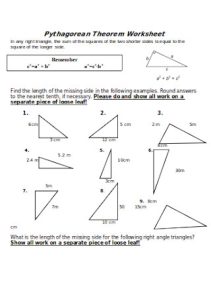
 The Pythagorean theorem is one of geometry’s most useful ideas: it connects the three sides of a right triangle and helps us find an unknown length. From calculating the height of a ladder against a wall to measuring a diagonal across a rectangular room, the theorem turns practical problems into manageable steps.
A well-designed Pythagorean theorem worksheet gives students a chance to practice those steps, recognize right triangles, and apply the concept to real situations. This guide explains what worksheets can cover, how to use them effectively, and what to look for when choosing or creating one.
What Is the Pythagorean Theorem?
The Pythagorean theorem states that, in a right triangle, the square of the hypotenuse equals the sum of the squares of the other two sides:
[ a^2+b^2=c^2 ]
Here, (a) and (b) are the legs—the sides that meet to form the right angle—and (c) is the hypotenuse, the side opposite the right angle. The hypotenuse is always the longest side.
For example, if the legs measure 3 and 4 units, then:
[ 3^2+4^2=9+16=25 ]
So (c=\sqrt{25}=5). The triangle has side lengths 3, 4, and 5.
A crucial reminder for worksheet practice: the theorem applies to right triangles, not to every triangle.
What Does a Pythagorean Theorem Worksheet Teach?
A worksheet can build several connected skills, from basic substitution to multi-step reasoning.
1. Finding the hypotenuse
Students are given the two legs and use the formula to find the missing hypotenuse. These problems are often a good starting point because the unknown is already represented by (c).
Example: The legs are 6 cm and 8 cm.
[ c^2=6^2+8^2=36+64=100,\qquad c=10 ]
The hypotenuse is 10 cm.
2. Finding a missing leg
When the hypotenuse and one leg are known, students rearrange the formula:
[ a^2=c^2-b^2 ]
Example: The hypotenuse is 13 m and one leg is 5 m.
[ a^2=13^2-5^2=169-25=144,\qquad a=12 ]
The missing leg is 12 m. This is a useful place to emphasize that students should subtract the square of the known leg from the square of the hypotenuse.
3. Working with square roots and decimals
Not every answer is a whole number. For example, if the legs are 5 and 7:
[ c=\sqrt{5^2+7^2}=\sqrt{74}\approx 8.60 ]
Depending on the instructions, students may leave the answer in exact form, (\sqrt{74}), or round it to a specified number of decimal places.
4. Checking whether a triangle is right
The theorem can also test whether three given side lengths form a right triangle. Students identify the longest side as (c), then check whether (a^2+b^2=c^2).
For side lengths 7, 24, and 25:
[ 7^2+24^2=49+576=625=25^2 ]
The triangle is a right triangle. This skill helps students see that the theorem is useful not only for finding lengths, but also for verifying relationships.
Common Types of Worksheet Problems
A comprehensive worksheet may include several formats so students learn to recognize when and how to use the theorem.
Diagram-based problems
A diagram labels two sides of a right triangle and asks for the third. These problems help students connect the equation to a visual model. Students should first mark the right angle and identify the hypotenuse before substituting values.
Word problems
Real-world contexts make the theorem more memorable. A problem might describe a ladder leaning against a wall, a ramp reaching a platform, or the diagonal distance across a rectangular field. Students must translate the situation into a right triangle before calculating.
Coordinate-plane problems
The theorem can find the distance between two points. The horizontal and vertical changes between the points become the legs of a right triangle.
For points ((x_1,y_1)) and ((x_2,y_2)), the distance is:
[ d=\sqrt{(x_2-x_1)^2+(y_2-y_1)^2} ]
For example, the distance between ((1,2)) and ((4,6)) is:
[ d=\sqrt{(4-1)^2+(6-2)^2} =\sqrt{9+16} =5 ]
Multi-step geometry problems
More advanced worksheets may use the theorem to find a diagonal, height, or side length within a larger figure. Students might need to split a shape into right triangles, identify a missing measurement, or combine the theorem with other geometry facts.
How to Solve Problems Reliably
A consistent routine can prevent many common mistakes:
- Confirm that the triangle is right. Look for a right-angle mark or information that establishes a 90-degree angle.
- Identify the hypotenuse. It is opposite the right angle and is the longest side.
- Choose the correct equation. Use (a^2+b^2=c^2), with (c) as the hypotenuse.
- Substitute the known lengths. Include units where appropriate.
- Solve for the squared unknown. Add when the hypotenuse is missing; subtract when a leg is missing.
- Take the square root. Remember that a side length is positive.
- Check the result. Does it make sense for the diagram and the units? Is the hypotenuse longer than either leg?
Showing each step matters. An answer alone may be difficult to check, while a written equation makes it easier to spot an arithmetic or setup error.
Common Mistakes to Watch For
Worksheets are most useful when students review not just correct answers, but also typical errors.
- Using the wrong side as the hypotenuse: The hypotenuse is opposite the right angle, not simply the side that looks longest in a rough sketch.
- Adding when finding a leg: If the hypotenuse is known, subtract the square of the known leg.
- Forgetting to take the square root: Solving for (c^2) is not the same as finding (c).
- Rounding too early: Keep exact values or carry several digits through the calculation, then round at the end if requested.
- Ignoring units: If the input is in centimeters, the final length should also be in centimeters.
- Applying the theorem to a non-right triangle: The right-angle condition is essential.
How Teachers and Families Can Use Worksheets Effectively
A worksheet works best as part of a learning sequence rather than as a collection of isolated calculations.
Start with a visual explanation
Use a labeled right triangle and connect each part of the formula to its corresponding side. Ask learners to point out the legs, the right angle, and the hypotenuse before solving.
Move from guided practice to independent work
Begin with worked examples, then solve a few problems together. After that, let students try similar questions independently. This gradual shift helps them build confidence without encouraging memorization alone.
Mix problem types
Include missing-hypotenuse and missing-leg questions, diagrams, word problems, and classification tasks. Varied practice helps students decide which method fits a problem instead of relying on a single pattern.
Ask students to explain their reasoning
Prompts such as “How did you identify the hypotenuse?” or “Why did you subtract here?” reveal whether a student understands the relationship or is only following a memorized procedure.
Review errors constructively
When checking work, focus on where the reasoning changed course. A student who chose the wrong side as (c) may need help reading the diagram; a student who stopped at (c^2=100) may need a reminder about square roots.
Choosing or Creating a Good Worksheet
A useful Pythagorean theorem worksheet should match the learner’s current level and make expectations clear. Look for:
- A brief reminder of the formula and a labeled diagram
- Problems that progress from straightforward to more challenging
- A mix of numerical, visual, and applied questions
- Clear instructions about rounding and exact answers
- Space to show work
- An answer key, ideally with steps for representative problems
- Accessible formatting and diagrams that are easy to read
For a custom worksheet, consider grouping questions by skill—first finding the hypotenuse, then finding a leg, then applying the theorem in context. A short mixed review at the end can show whether students can choose the right approach on their own.
Conclusion
A Pythagorean theorem worksheet can do more than provide repetitive practice. It can help students understand the relationship between the sides of a right triangle, strengthen square-root skills, and connect geometry to everyday measurements. The most effective practice asks learners to identify the right triangle, choose the correct side as the hypotenuse, show each step, and check whether the answer makes sense.
With clear examples, varied questions, and thoughtful review, worksheets can turn a familiar formula into a flexible problem-solving tool.
Sources
- OpenStax, Prealgebra 2e, “Use the Pythagorean Theorem”: https://openstax.org/books/prealgebra-2e/pages/9-4-use-the-pythagorean-theorem
- OpenStax, College Algebra 2e, “The Distance Formula”: https://openstax.org/books/college-algebra-2e/pages/5-1-the-distance-and-midpoint-formulas-and-circles
- Encyclopaedia Britannica, “Pythagorean theorem”: https://www.britannica.com/science/Pythagorean-theorem