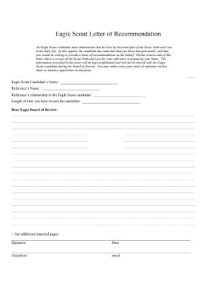
 An Eagle Scout recommendation letter is more than a character reference. It gives a member of a Scout’s community the chance to describe how the Scout lives the ideals of Scouting—such as trustworthiness, service, leadership, and responsibility—in everyday life. A thoughtful letter can help the Eagle Scout Board of Review understand the candidate’s character beyond the activities and achievements listed in an application.
If you have been asked to write one, you may be wondering what to include, how formal to make it, or how to handle the request for a confidential reference. This guide explains the purpose of the letter, offers practical writing tips, and includes a sample you can adapt.
What Is an Eagle Scout Recommendation Letter?
As part of the Eagle Scout rank process, a candidate provides references who can speak to their character and qualifications. The Eagle Scout application asks for references in areas that can include the candidate’s parent or guardian, religious institution, educational setting, employer, and other personal references. The precise requirements and process may depend on the application instructions and local council procedures.
A recommendation letter is not a vote on whether the candidate should earn the rank. Instead, it should give an honest, firsthand account of the young person’s character, conduct, and growth. The Eagle Scout Board of Review considers the candidate’s record and may use reference letters as part of its broader review.
Important: Follow the instructions provided by the candidate, troop, or local council. Some councils ask references to submit letters directly and confidentially rather than giving them to the candidate.
Who Should Write the Letter?
The best recommender is someone who knows the candidate well enough to offer specific, credible observations. That person might be a:
- Teacher, coach, or school counselor
- Employer or workplace supervisor
- Religious or community leader
- Volunteer coordinator
- Neighbor, family friend, or mentor
- Other adult who has observed the Scout’s character over time
A recommender does not need to be an Eagle Scout. They should, however, be able to describe the candidate from their own experience rather than relying only on what others have said.
If you do not know the candidate well, it is better to decline politely than to write a generic letter that overstates your knowledge.
What Should the Letter Say?
A strong recommendation is sincere, specific, and concise. In most cases, one page is enough. Consider including the following elements:
1. Your relationship to the candidate
Explain who you are, how you know the Scout, and how long you have known them. This helps the reader understand the context for your observations.
2. Firsthand examples
Rather than relying on broad praise—such as “He is a great leader”—describe an occasion that shows the candidate’s leadership, kindness, reliability, or initiative.
For example:
During our community clean-up, Jordan noticed that several volunteers were unsure where to begin. He calmly organized small teams, explained the tasks, and stayed afterward to make sure the equipment was returned.
3. Connection to Scouting values
If you are familiar with the Scout Oath and Scout Law, you may refer to values such as being trustworthy, helpful, courteous, or reverent. Connect those words to real examples instead of simply listing them.
You do not have to assess every Scout Law point. A few well-supported observations are more useful than a checklist.
4. Growth and responsibility
If you have seen the Scout develop over time, describe that growth. Perhaps they have become more dependable, learned to accept feedback, or taken responsibility for a difficult task.
5. Your honest recommendation
Close by stating your view of the candidate’s character and suitability for the Eagle Scout rank. Keep your endorsement accurate and grounded in what you have observed.
Sample Eagle Scout Recommendation Letter
Use the sample below as a starting point. Replace the bracketed details with your own, and avoid keeping any statement that does not reflect your genuine experience.
[Your Name]
[Your Title or Organization, if applicable]
[Address or Email, if requested]
[Date]To the Eagle Scout Board of Review:
I am pleased to provide a character reference for [Scout’s Full Name], whom I have known for [length of time] as [explain your relationship—for example, a teacher, coach, employer, or community volunteer].
In my experience, [Scout’s First Name] is a [choose accurate qualities, such as dependable, considerate, or responsible] young person. One example that stands out is [briefly describe a specific situation]. In that situation, [explain what the Scout did and what it showed about their character].
I have also observed [Scout’s First Name] demonstrate [another relevant quality, such as initiative, service, perseverance, or respect for others]. [Add a short example or explanation.] These qualities are reflected in the way [he/she/they] works with others and follows through on commitments.
Based on what I have personally observed, I believe [Scout’s Full Name] demonstrates strong character and a sincere commitment to serving others. I am happy to recommend [him/her/them] for consideration for the rank of Eagle Scout.
Sincerely,
[Your Signature, if submitting a printed letter]
[Your Printed Name]
[Your Contact Information, if requested]
Tips for Making the Letter Stronger
Be specific, not extravagant
A grounded example is usually more persuasive than superlatives. “She stayed late to help a new volunteer finish the setup” tells the reader more than “She is the best person I have ever known.”
Write in your own voice
The letter should sound like you, not like a formal template. Professional and respectful language is appropriate, but it does not need to be stiff.
Keep it focused
You do not need to summarize the Scout’s entire Scouting history. The purpose is to share your perspective on the candidate’s character and conduct.
Be truthful
Do not claim personal knowledge you do not have or make promises about how the candidate will act in the future. If you have concerns, follow the official instructions for communicating them rather than disguising or omitting information that you are specifically asked to address.
Respect confidentiality
Ask how and where the letter should be submitted. Do not assume the Scout should receive a copy. If the reference form or local instructions specify a confidential process, follow it.
Proofread before submitting
Check the candidate’s name, pronouns, rank, and other details. A polished letter should be free of avoidable spelling and grammar errors.
Common Mistakes to Avoid
- Using only generic praise: Include at least one meaningful example.
- Writing an overly long biography: Focus on your own observations.
- Listing every Scout Law point: Discuss only the qualities you can genuinely support.
- Making claims you cannot verify: Separate firsthand knowledge from what you have heard.
- Ignoring submission instructions: Follow the candidate’s or council’s stated process.
- Treating the letter as a guarantee: Recommend the candidate honestly; the Board of Review makes its own decision.
Frequently Asked Questions
Does the recommender have to be an Eagle Scout?
Generally, a reference is selected because they know the candidate and can speak honestly about their character—not because they hold the Eagle Scout rank. Follow the current application and local council instructions for reference requirements.
How long should the letter be?
A concise letter of roughly one page is usually sufficient. The quality of the examples matters more than the length.
Should I mention the Scout Oath and Scout Law?
You may, especially if you can connect their principles to specific behavior. It is not necessary to quote them at length.
What if I cannot write a positive recommendation?
Be honest and respectful. Check the candidate’s instructions or contact the appropriate troop or council representative for guidance on how to submit a reference or raise a concern confidentially.
Conclusion
A meaningful Eagle Scout recommendation letter does not need elaborate language. It needs an honest account of how the candidate behaves and contributes, supported by examples you have personally observed. Explain your relationship, describe the qualities you have seen, and follow the requested submission process. A brief, sincere letter can give the Board of Review a useful picture of the Scout as a person.
Sources
- Boy Scouts of America, Eagle Scout Rank Application (application and reference information): Scouting.org — Eagle Scout Rank Application
- Boy Scouts of America, Guide to Advancement (official advancement policies and procedures): Scouting.org — Guide to Advancement
- Boy Scouts of America, Scout Oath and Scout Law: Scouting.org — Scout Oath and Scout Law