Asynchronous Meeting Agenda
Asynchronous Meeting Agenda: A Guide to Productive Collaboration Across Time Zones
In today’s increasingly distributed and globalized work environment, asynchronous meetings have emerged as a powerful alternative to traditional, real-time gatherings. These meetings, conducted without requiring participants to be present simultaneously, offer numerous advantages, including increased flexibility, reduced meeting fatigue, and improved accessibility for team members across different time zones. However, to ensure that asynchronous meetings are effective and productive, a well-structured agenda is crucial. This document outlines the key components of an asynchronous meeting agenda, providing a framework for successful collaboration and decision-making.
I. Purpose and Objectives
Before crafting the agenda, it is essential to define the meeting’s purpose and objectives clearly. What problem are we trying to solve? What decisions need to be made? What information needs to be shared? The answers to these questions will guide the agenda’s content and structure. A well-defined purpose ensures that participants understand the meeting’s goals and can contribute effectively.
The agenda should explicitly state the meeting’s purpose in a concise and easily understandable manner. For example:
- Purpose: To review and finalize the Q3 marketing strategy.
- Purpose: To gather feedback on the proposed redesign of the user interface.
- Purpose: To brainstorm potential solutions to the recent decline in customer satisfaction.
In addition to the overall purpose, the agenda should outline specific objectives for the meeting. These objectives should be measurable and achievable within the asynchronous format. For example:
- Objective: To obtain feedback from all team members on the proposed marketing budget allocation.
- Objective: To identify at least three key areas for improvement in the user interface design.
- Objective: To generate a list of at least five potential solutions to address customer satisfaction issues.
II. Agenda Items and Structure
The agenda should be structured logically and include clear, concise agenda items that align with the meeting’s purpose and objectives. Each agenda item should be specific enough to guide participants’ contributions and prevent ambiguity.
Here are some common agenda items for asynchronous meetings:
- Introductions (if needed): For new team members or projects, a brief introduction can help everyone get acquainted. This can be done through written bios or short video recordings.
- Review of Previous Meeting Notes: If the asynchronous meeting is a continuation of a previous discussion, the agenda should include a brief review of the key takeaways and action items from the prior meeting.
- Information Sharing: This section is used to disseminate relevant information to the team. This could include project updates, market research findings, or changes to company policies. The information should be presented in a clear and concise format, such as a document, presentation, or video recording.
- Discussion Topics: This is the core of the asynchronous meeting. Each discussion topic should be clearly defined and accompanied by relevant background information. Participants should be encouraged to share their thoughts, ideas, and feedback in a structured manner.
- Decision Points: This section outlines the key decisions that need to be made during the meeting. Clear options should be presented, and participants should be given the opportunity to vote or provide their rationale for their preferred choice.
- Action Items: Based on the discussions and decisions made, specific action items should be assigned to individual team members. Each action item should have a clear deadline and expected outcome.
- Open Discussion/Q&A: This section provides an opportunity for participants to raise any additional questions or concerns.
- Next Steps: This section outlines the next steps in the process, including the schedule for the next asynchronous meeting or any follow-up activities.
The order of agenda items should be logical and flow naturally from one topic to the next. Consider starting with informational items to provide context before moving on to discussion and decision-making.
III. Supporting Materials and Context
To ensure that participants can contribute effectively, the agenda should include links to all relevant supporting materials, such as documents, presentations, spreadsheets, and videos. Providing this information in advance allows participants to review the materials at their own pace and come prepared to contribute to the discussion.
In addition to providing supporting materials, it is important to provide context for each agenda item. This could include a brief summary of the issue being discussed, relevant background information, or a statement of the desired outcome. Providing context helps participants understand the importance of the topic and ensures that their contributions are focused and relevant.
IV. Timeboxing and Deadlines
While asynchronous meetings offer flexibility, it is important to set clear deadlines for participation to ensure that the meeting stays on track. Assigning estimated timeframes for each agenda item can also help participants prioritize their time and focus on the most important topics. Clearly state the deadline for each action item.
The agenda should clearly specify the deadline for participants to review the materials and provide their input. It should also specify the timeframe for each discussion topic. For example:
- Review of Marketing Budget (Deadline: Friday, October 27th, 5:00 PM PST): Please review the attached marketing budget proposal and provide your feedback by Friday.
- Discussion: User Interface Redesign (Timeframe: October 23rd – October 27th): This discussion will be open for contributions for five days.
V. Platform and Communication Guidelines
The agenda should specify the platform that will be used for the asynchronous meeting, such as a project management tool, a dedicated forum, or a shared document. It should also outline the communication guidelines for the meeting, including expectations for response times, formatting of contributions, and the use of appropriate language.
For example:
- Platform: We will be using the “Project X” project management tool for this asynchronous meeting.
- Communication Guidelines: Please use clear and concise language in your contributions. Respond to other participants’ comments respectfully. Try to keep replies short and on topic.
VI. Facilitation and Moderation
Even in an asynchronous format, facilitation is crucial. Designate a facilitator to guide the discussion, ensure that all participants have the opportunity to contribute, and keep the meeting on track. The facilitator should also be responsible for summarizing key takeaways and assigning action items.
The facilitator should actively monitor the discussion, answer questions, and encourage participation from all team members. They should also be prepared to intervene if the discussion becomes unproductive or off-topic.
VII. Review and Iteration
After each asynchronous meeting, take time to review the agenda and the meeting’s outcome. What worked well? What could be improved? Use this feedback to refine the agenda for future asynchronous meetings.
By consistently reviewing and iterating on the agenda, you can ensure that your asynchronous meetings become increasingly effective and productive.
By following these guidelines, you can create asynchronous meeting agendas that promote effective collaboration, informed decision-making, and efficient use of time, regardless of geographical location or scheduling constraints.
 1280×720 asynchronous video meetings future work from www.fastcompany.com
  3840×2160 built asynchronous meeting software works from geekbot.com
  4800×3060 meeting agenda template staff formal kickoff asana from asana.com
  2560×1632 interactive meeting agenda template invitation template ideas from howtostepmom.com
 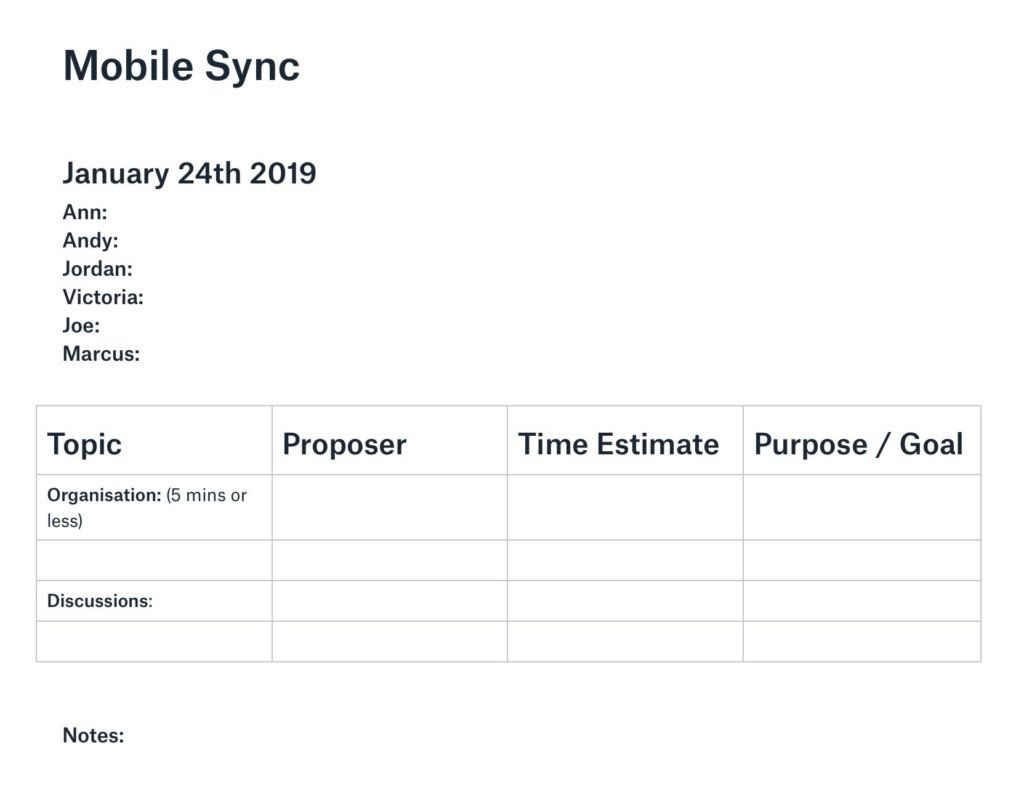 1024×788 happened team switched asynchronous meetings from buffer.com
  1024×785 meeting agenda examples ready templates hypercontext from hypercontext.com




Asynchronous Meeting Agenda :
Asynchronous Meeting Agenda was posted in December 8, 2025 at 1:51 pm. If you wanna have it as yours, please click the Pictures and you will go to click right mouse then Save Image As and Click Save and download the Asynchronous Meeting Agenda Picture.. Don’t forget to share this picture with others via Facebook, Twitter, Pinterest or other social medias! we do hope you'll get inspired by SampleTemplates123... Thanks again! If you have any DMCA issues on this post, please contact us!