Project Plan Template For Research Project
Research Project Plan Template
A well-structured research project plan is crucial for the successful execution and completion of any research endeavor. It serves as a roadmap, outlining the project’s objectives, methodology, timeline, and resources. This template provides a comprehensive framework for developing a robust research project plan.
I. Project Overview
1.1 Project Title
Clearly and concisely state the title of your research project. This should reflect the core subject matter and be easily understandable.
1.2 Project Summary/Abstract
Provide a brief overview of the project (150-200 words). This should include the research question, the proposed methodology, the expected outcomes, and the project’s significance.
1.3 Project Goals and Objectives
Goals: Broad, overarching statements describing the desired long-term impact of the research. For example: “To improve understanding of the effects of social media on adolescent mental health.”
Objectives: Specific, measurable, achievable, relevant, and time-bound (SMART) steps required to achieve the project goals. For example: “To conduct a survey of 500 adolescents aged 13-18 to assess their social media usage and mental well-being within six months.”
1.4 Project Significance and Rationale
Explain the importance of the research project. Why is this research needed? What gap in knowledge will it fill? How will the findings contribute to the field, and what are the potential practical applications or benefits?
II. Literature Review
2.1 Background and Context
Summarize the existing literature relevant to the research topic. This should provide context for the project, highlighting key findings, theories, and debates. It should also identify any gaps in the current knowledge base.
2.2 Theoretical Framework
Describe the theoretical framework that will guide the research. What theories or models will be used to interpret the data and explain the findings? Explain why this framework is appropriate for the research question.
2.3 Research Questions/Hypotheses
Research Questions: Clearly articulate the specific questions that the research aims to answer.
Hypotheses: If applicable, state the specific, testable predictions that the research will investigate.
III. Methodology
3.1 Research Design
Specify the overall research design (e.g., experimental, correlational, descriptive, qualitative, quantitative, mixed methods). Justify the chosen design and explain why it is the most appropriate approach for addressing the research question.
3.2 Participants/Sample
Describe the target population and the sampling method that will be used to select participants. Include details about sample size, inclusion/exclusion criteria, and any ethical considerations related to participant recruitment and data collection.
3.3 Data Collection Methods
Detail the specific methods that will be used to collect data (e.g., surveys, interviews, experiments, observations, document analysis). Describe the instruments or tools that will be used (e.g., questionnaires, interview protocols, experimental procedures). Ensure the instruments are reliable and valid.
3.4 Data Analysis Techniques
Explain how the collected data will be analyzed. Specify the statistical or qualitative analysis techniques that will be used to answer the research questions or test the hypotheses. For quantitative data, describe the statistical software that will be used. For qualitative data, describe the methods for coding and interpreting the data.
3.5 Ethical Considerations
Outline the ethical considerations related to the research project, including informed consent, confidentiality, anonymity, and data security. Explain how these considerations will be addressed to ensure the ethical integrity of the research. If applicable, mention Institutional Review Board (IRB) approval.
IV. Project Timeline and Deliverables
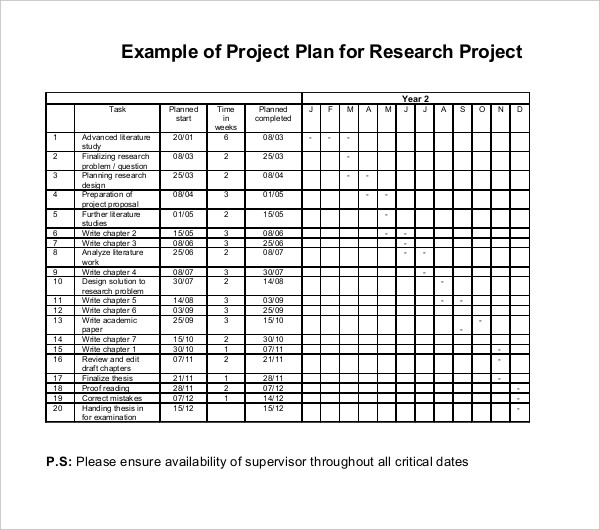
4.1 Project Timeline (Gantt Chart)
Create a detailed timeline outlining all key project activities, including start and end dates for each task. Use a Gantt chart or similar visual representation to illustrate the project schedule. Example tasks include: Literature review, instrument development, data collection, data analysis, report writing, presentation preparation.
4.2 Deliverables
List all tangible outputs of the research project. Examples include: Literature review, research instruments, datasets, interim reports, final report, presentations, publications.
V. Resources and Budget
5.1 Required Resources
Identify all resources required for the project, including personnel, equipment, software, materials, and travel. Be specific about the quantity and type of each resource needed.
5.2 Budget
Develop a detailed budget outlining all anticipated expenses associated with the project. Categorize expenses (e.g., personnel costs, equipment costs, travel costs, data collection costs, publication costs) and provide a justification for each item.
VI. Project Management and Communication
6.1 Project Team and Roles
Identify all members of the research team and their respective roles and responsibilities. Clearly define lines of communication and decision-making authority.
6.2 Communication Plan
Outline the strategy for communication within the research team and with external stakeholders. Specify the frequency and methods of communication (e.g., weekly meetings, email updates, progress reports).
6.3 Risk Management
Identify potential risks or challenges that could impact the project’s success (e.g., participant recruitment difficulties, data collection problems, equipment failures). Develop a plan for mitigating these risks.
VII. Dissemination Plan
7.1 Target Audience
Identify the intended audience for the research findings (e.g., academics, policymakers, practitioners, the general public).
7.2 Dissemination Strategies
Describe the strategies that will be used to disseminate the research findings to the target audience. Examples include: Publications in peer-reviewed journals, presentations at conferences, reports to stakeholders, media outreach, social media dissemination.
VIII. Evaluation Plan
8.1 Evaluation Metrics
Define the metrics that will be used to evaluate the success of the research project. Examples include: Number of publications, number of presentations, impact factor of journals, reach of media coverage, adoption of research findings by practitioners.
8.2 Evaluation Methods
Describe the methods that will be used to collect data to evaluate the project’s success. Examples include: Tracking publications and presentations, monitoring media coverage, surveying stakeholders, analyzing data on adoption of research findings.
IX. Appendices
Include any supplementary materials, such as: Copies of research instruments, consent forms, letters of support, detailed budget breakdowns.
This template provides a flexible framework that can be adapted to suit the specific needs of individual research projects. Remember to consult with advisors, mentors, or experienced researchers to refine your project plan and ensure its feasibility and rigor.
 600×530 research project plan templates from www.template.net
  880×1243 research plans templates format templatenet from www.template.net
  440×570 research plan templates edit templatenet from www.template.net
  600×730 sample research project templates ms word from www.sampletemplates.com
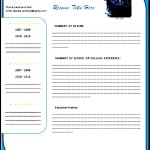


Project Plan Template For Research Project :
Project Plan Template For Research Project was posted in May 14, 2025 at 1:29 pm. If you wanna have it as yours, please click the Pictures and you will go to click right mouse then Save Image As and Click Save and download the Project Plan Template For Research Project Picture.. Don’t forget to share this picture with others via Facebook, Twitter, Pinterest or other social medias! we do hope you'll get inspired by SampleTemplates123... Thanks again! If you have any DMCA issues on this post, please contact us!