Strength Training Plan Template
Crafting Your Ideal Strength Training Plan: A Template for Success
Embarking on a strength training journey requires more than just hitting the gym; it demands a well-structured plan. A solid strength training plan provides direction, tracks progress, and maximizes results. Think of it as a roadmap, guiding you towards your fitness goals. This template offers a flexible framework you can customize to fit your individual needs and aspirations.
Understanding the Building Blocks
Before diving into the template, let’s cover the fundamental elements of any effective strength training program:
- Goal Setting: Define your objectives. Are you aiming for muscle hypertrophy (growth), strength gains, improved endurance, or overall fitness? Specific, measurable, achievable, relevant, and time-bound (SMART) goals are crucial.
- Exercise Selection: Choose exercises that target your desired muscle groups and align with your fitness level. Compound exercises (squats, deadlifts, bench press, overhead press, rows) engage multiple muscle groups simultaneously, promoting greater overall strength and muscle growth. Isolation exercises (bicep curls, tricep extensions, calf raises) focus on specific muscles for targeted development.
- Sets and Repetitions: Sets refer to the number of times you perform a group of repetitions. Repetitions (reps) are the number of times you perform an exercise in a set. The optimal rep range varies depending on your goals. Generally, lower reps (1-5) with heavier weight are ideal for strength, moderate reps (6-12) for hypertrophy, and higher reps (15+) for endurance.
- Rest Intervals: Allow sufficient rest between sets to allow your muscles to recover and prepare for the next set. Longer rest intervals (2-3 minutes) are typically used for heavier lifts and lower rep ranges, while shorter rest intervals (30-60 seconds) are suitable for higher rep ranges and circuit training.
- Training Frequency: How often you train each muscle group per week. A common approach is to train each muscle group 2-3 times per week, allowing adequate recovery time between sessions.
- Progression: Gradually increase the weight, reps, sets, or difficulty of your exercises over time to continually challenge your muscles and promote adaptation. This is essential for long-term progress. Methods include adding weight, increasing reps, reducing rest, or trying more challenging variations of an exercise.
- Warm-up and Cool-down: Always begin with a dynamic warm-up to prepare your muscles for exercise and reduce the risk of injury. End with a static stretching cool-down to improve flexibility and reduce muscle soreness.
The Strength Training Plan Template
This template is designed to be adaptable to your individual needs. Adjust the exercises, sets, reps, and rest intervals to match your current fitness level and goals. Remember to consult with a qualified healthcare professional or certified personal trainer before starting any new exercise program.
Template Structure
The template outlines a four-day split, targeting different muscle groups on each day. You can adjust the split based on your training frequency and preferences. For example, a three-day full-body split or a five-day body part split are also viable options.
Day 1: Upper Body Push (Chest, Shoulders, Triceps)
- Exercise 1: Bench Press (3 sets of 6-8 reps)
- Exercise 2: Incline Dumbbell Press (3 sets of 8-12 reps)
- Exercise 3: Overhead Press (3 sets of 6-8 reps)
- Exercise 4: Lateral Raises (3 sets of 10-15 reps)
- Exercise 5: Tricep Pushdowns (3 sets of 12-15 reps)
- Exercise 6: Close-Grip Bench Press (3 sets of 8-12 reps)
Day 2: Lower Body (Quads, Hamstrings, Glutes, Calves)
- Exercise 1: Squats (3 sets of 6-8 reps)
- Exercise 2: Romanian Deadlifts (3 sets of 8-12 reps)
- Exercise 3: Leg Press (3 sets of 10-15 reps)
- Exercise 4: Leg Extensions (3 sets of 12-15 reps)
- Exercise 5: Hamstring Curls (3 sets of 12-15 reps)
- Exercise 6: Calf Raises (3 sets of 15-20 reps)
Day 3: Rest or Active Recovery
Engage in light activities such as walking, yoga, or swimming to promote blood flow and recovery.
Day 4: Upper Body Pull (Back, Biceps)
- Exercise 1: Pull-ups (3 sets of as many reps as possible – AMRAP)
- Exercise 2: Barbell Rows (3 sets of 6-8 reps)
- Exercise 3: Lat Pulldowns (3 sets of 8-12 reps)
- Exercise 4: Face Pulls (3 sets of 12-15 reps)
- Exercise 5: Bicep Curls (3 sets of 10-15 reps)
- Exercise 6: Hammer Curls (3 sets of 10-15 reps)
Day 5: Full Body/Accessory Work
- Exercise 1: Deadlifts (1 set of 5 reps, 1 set of 3 reps, 1 set of 1 rep – focus on form)
- Exercise 2: Dumbbell Lunges (3 sets of 10-12 reps per leg)
- Exercise 3: Plank (3 sets, hold for 30-60 seconds)
- Exercise 4: Russian Twists (3 sets of 15-20 reps per side)
- Exercise 5: Any additional exercises targeting lagging muscle groups.
Day 6 & 7: Rest
Allow your body to fully recover before your next training week.
Customization and Progression
This template is a starting point. Here’s how to customize and progress:
* **Exercise Selection:** Swap exercises based on your preferences, available equipment, and any injuries or limitations. * **Set and Rep Ranges:** Adjust the sets and reps based on your goals. Increase weight when you can comfortably perform the upper end of the rep range for all sets. * **Progression:** Implement progressive overload. Aim to increase the weight lifted each week, even if it’s just by a small amount. * **Deload:** Schedule a deload week every 4-6 weeks, where you reduce the weight and volume of your training by 50% to allow your body to recover and prevent overtraining. * **Listen to Your Body:** Pay attention to your body’s signals. If you’re feeling excessively fatigued or experiencing pain, take a rest day or reduce the intensity of your workouts.
Important Considerations
* **Proper Form:** Prioritize proper form over lifting heavy weight. Poor form can lead to injuries. * **Nutrition and Hydration:** Support your training with a healthy diet and adequate hydration. * **Sleep:** Get sufficient sleep to allow your body to recover and rebuild muscle. * **Consistency:** The key to success is consistency. Stick to your plan as much as possible and don’t get discouraged by setbacks.
By using this strength training plan template and tailoring it to your specific needs, you can create a program that will help you achieve your fitness goals. Remember to be patient, consistent, and listen to your body. Good luck!
 820×407 training plan template mt home arts from mthomearts.com
 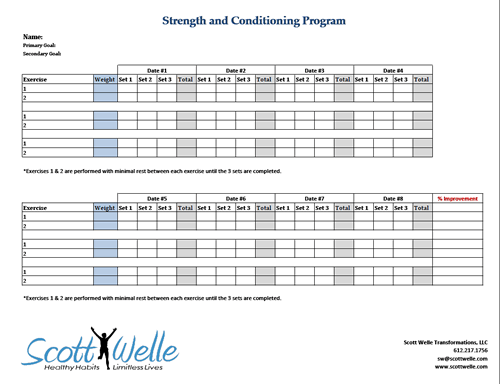 500×384 strength training program template scott welle outperform norm from scottwelle.com
 .jpg) 1654×2339 strength training workout schedule template microsoft word from www.template.net
1654×2339 strength training workout schedule template microsoft word from www.template.net  1762×1248 excel strength training template collection from lesboucans.com
  1024×1446 training plan templates edit templatenet from www.template.net
  675×520 strength training template excel collection from lesboucans.com
  600×580 sample training plan templates google docs ms word from www.sampletemplates.com
  1141×566 strength training workout sheets strength training from myexceltemplates.com
  3300×2550 workout plan template word planner template from www.plannertemplatefree.com


Strength Training Plan Template :
Strength Training Plan Template was posted in October 25, 2025 at 3:53 am. If you wanna have it as yours, please click the Pictures and you will go to click right mouse then Save Image As and Click Save and download the Strength Training Plan Template Picture.. Don’t forget to share this picture with others via Facebook, Twitter, Pinterest or other social medias! we do hope you'll get inspired by SampleTemplates123... Thanks again! If you have any DMCA issues on this post, please contact us!