Monthly Budget Template With Formulas
“`html
Creating a Powerful Monthly Budget Template with Formulas
Budgeting is the cornerstone of sound financial management. It provides a clear roadmap for your income and expenses, enabling you to track your progress toward financial goals, identify areas for improvement, and ultimately gain control over your money. A well-designed monthly budget template, especially one enhanced with formulas, can significantly simplify this process.
Why Use a Budget Template with Formulas?
While pen-and-paper budgeting is a start, a template with formulas offers significant advantages:
- Automation: Formulas automate calculations, such as totals, differences (income vs. expenses), and percentages. This eliminates manual errors and saves time.
- Real-time Insights: As you input data, formulas instantly update, providing real-time feedback on your spending and remaining budget.
- Scenario Planning: You can easily experiment with different scenarios, like increasing savings or reducing expenses, and see the immediate impact on your overall budget.
- Consistency: A template ensures a consistent budgeting process month after month, making it easier to track trends and identify patterns.
- Customization: Templates are highly customizable. You can adapt them to fit your specific income sources, expense categories, and financial goals.
Building Your Monthly Budget Template
Let’s outline the key components of a robust monthly budget template. We’ll focus on the formulas needed to automate calculations.
1. Income Section
This section lists all sources of income. Common entries include:
- Salary/Wages (after taxes)
- Freelance Income
- Investment Income (dividends, interest)
- Rental Income
- Other Income (e.g., side hustle income)
Formulas:
- Total Income: This formula sums up all the individual income entries. In a spreadsheet program like Excel or Google Sheets, this would look something like
=SUM(B2:B7)(assuming income entries are in cells B2 to B7). This formula will automatically update if you add or change any income amounts.
2. Expenses Section
This is the most detailed section, as it breaks down all your outgoing expenses into various categories. Careful categorization is crucial for identifying spending patterns.
Common expense categories include:
- Housing: Rent/Mortgage, Property Taxes, Home Insurance, HOA fees
- Utilities: Electricity, Gas, Water, Internet, Phone
- Transportation: Car Payment, Car Insurance, Gas, Public Transportation, Maintenance
- Food: Groceries, Dining Out
- Insurance: Health Insurance, Life Insurance, Disability Insurance
- Debt Payments: Credit Card Payments, Student Loans, Personal Loans
- Savings: Emergency Fund, Retirement Savings, Investment Accounts
- Personal Care: Haircuts, Cosmetics, Gym Membership
- Entertainment: Movies, Concerts, Streaming Services
- Clothing: Clothes, Shoes
- Gifts: Birthdays, Holidays
- Miscellaneous: Subscriptions, Donations, Unexpected Expenses
Formulas:
- Total Expenses per Category: Within each category (e.g., Housing), sum the individual expense entries. For example, if you have Rent, Property Taxes, and Home Insurance under Housing, the formula would be
=SUM(C2:C4)(assuming these expenses are in cells C2 to C4). - Total Expenses: Sum all the category totals. This will give you your total monthly expenses. The formula would be
=SUM(D2:D10)(assuming category totals are in cells D2 to D10).
3. Savings/Debt Reduction Section
This section explicitly tracks your progress toward financial goals, such as building an emergency fund, paying down debt, and saving for retirement.
- Emergency Fund Contributions
- Retirement Account Contributions (401k, IRA)
- Debt Paydown (above minimum payments)
- Investment Account Contributions
- Savings Goals (e.g., down payment for a house)
Formulas:
- Total Savings/Debt Reduction: Sum all the contributions listed in this section. The formula is similar to the others:
=SUM(E2:E5)(assuming these values are in cells E2 to E5).
4. Summary Section
This section provides a concise overview of your budget and highlights key metrics.
- Total Income: (Linked from the Income Section)
- Total Expenses: (Linked from the Expenses Section)
- Total Savings/Debt Reduction: (Linked from the Savings/Debt Reduction Section)
- Net Income (Surplus/Deficit): This is the most important calculation. It determines whether you are spending less than you earn (surplus) or more than you earn (deficit).
Formulas:
- Net Income (Surplus/Deficit): Subtract Total Expenses and Total Savings/Debt Reduction from Total Income. For example, if Total Income is in cell F2, Total Expenses is in cell F3, and Total Savings/Debt Reduction is in cell F4, the formula would be
=F2-(F3+F4). A positive result indicates a surplus; a negative result indicates a deficit. - Percentage of Income Saved: Divide Total Savings/Debt Reduction by Total Income and multiply by 100 to express it as a percentage. The formula would be
=(F4/F2)*100, and you’d need to format the cell as a percentage.
Template Design Considerations
- Clarity and Organization: Use clear headings, subheadings, and color-coding to enhance readability and make the template easy to navigate.
- Flexibility: Design the template to accommodate future income sources, expense categories, or savings goals. Allow for easy addition or deletion of rows.
- Real vs. Actual: Include columns for “Budgeted” amounts (your planned spending) and “Actual” amounts (your actual spending). Add a third column to calculate the “Difference” (Budgeted – Actual) to track your spending performance. This allows for variance analysis.
- Conditional Formatting: Use conditional formatting to highlight areas where you are overspending (e.g., turning cells red when “Actual” exceeds “Budgeted”) or exceeding savings goals (e.g., turning cells green).
- Data Validation: Implement data validation to ensure that only valid data types (e.g., numbers) are entered into specific cells, reducing the risk of errors.
- Charts and Graphs: Visualize your budget data with charts and graphs (pie charts for expense allocation, line graphs for tracking income and expenses over time). This makes it easier to identify trends and patterns at a glance.
Example Formulas in Action
Let’s assume the following cell locations (you can adjust these to fit your specific template layout):
- A1: Total Income
- A2: Total Expenses
- A3: Total Savings
- A4: Net Income (Surplus/Deficit)
Then the formulas would be:
- A4 (Net Income):
=A1-(A2+A3)
Let’s say you have these expenses:
- B1: Rent = $1500
- B2: Groceries = $400
- B3: Utilities = $200
Then, to calculate total expenses in cell A2:
- A2 (Total Expenses):
=SUM(B1:B3)
Tips for Effective Budgeting
- Track Your Spending: Diligently track your actual spending throughout the month. Use a budgeting app, spreadsheet, or even a notebook to record your expenses.
- Review Your Budget Regularly: Don’t just create a budget and forget about it. Review your budget at least weekly, if not daily, to identify areas where you are overspending or underspending.
- Adjust Your Budget as Needed: Life is dynamic, and your budget should be too. Adjust your budget as needed to reflect changes in your income, expenses, or financial goals.
- Be Realistic: Set realistic expectations for your spending and savings. Don’t try to cut back too drastically, as this can lead to discouragement and make you more likely to abandon your budget altogether.
- Automate Savings: Automate your savings contributions to ensure that you are consistently saving towards your financial goals. Set up automatic transfers from your checking account to your savings account or investment accounts.
- Seek Professional Advice: If you are struggling to manage your finances, consider seeking advice from a financial advisor.
Conclusion
A well-designed monthly budget template with formulas is a powerful tool for managing your finances. By automating calculations, providing real-time insights, and allowing for scenario planning, it empowers you to take control of your money, track your progress toward financial goals, and build a more secure financial future. By consistently using and adapting your budget, you can gain valuable insights into your spending habits and make informed decisions that will lead you to financial success.
“`
 1400×859 printable monthly budget template db excelcom from db-excel.com
  600×730 excel monthly budget templates word excel pages from www.template.net
 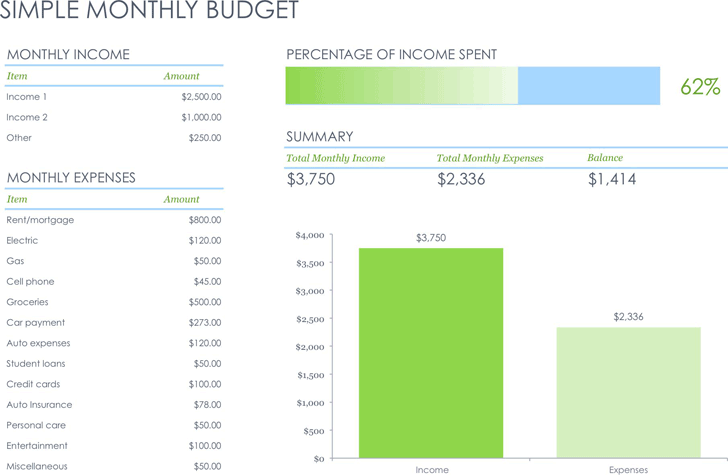 728×475 simple monthly budget templatessss db excelcom from db-excel.com
  736×1079 excel monthly budget template excelxocom from excelxo.com


Monthly Budget Template With Formulas :
Monthly Budget Template With Formulas was posted in January 10, 2026 at 10:42 pm. If you wanna have it as yours, please click the Pictures and you will go to click right mouse then Save Image As and Click Save and download the Monthly Budget Template With Formulas Picture.. Don’t forget to share this picture with others via Facebook, Twitter, Pinterest or other social medias! we do hope you'll get inspired by SampleTemplates123... Thanks again! If you have any DMCA issues on this post, please contact us!
Related For Monthly Budget Template With Formulas

Editable Project Budget Template Ex
Editable Project Budget Template Excel Download Texas Quit Claim
Simple Budget Worksheet PDF Downloa
Simple Budget Worksheet PDF Download Sample EEOC Complaint FormLoveBudget And Debt Payoff Template Kit
Here’s a comprehensive guide to a budget and debt