Board Meeting Agenda Format
Board Meeting Agenda: A Comprehensive Guide
A well-crafted board meeting agenda is the cornerstone of effective governance. It’s the roadmap that guides discussions, ensures productive use of time, and ultimately contributes to informed decision-making. Without a clear and comprehensive agenda, meetings can easily devolve into unfocused discussions, leaving board members frustrated and important issues unresolved.
Key Elements of a Successful Board Meeting Agenda
The following components are essential for creating an agenda that facilitates a smooth and productive board meeting:
- Meeting Information: This section provides the foundational details for the meeting.
- Meeting Title: Clearly state “Board of Directors Meeting” or a similarly descriptive title.
- Date and Time: Specify the exact date and time the meeting will commence.
- Location: Indicate the physical address or virtual meeting link.
- Attendees: List all expected attendees, including board members, key executives, and any invited guests. It can be helpful to denote roles or titles beside each name.
- Call to Order: This formal opening marks the official start of the meeting. The chairperson usually calls the meeting to order.
- Approval of Minutes: This section addresses the review and approval of the minutes from the previous board meeting.
- Provide board members with the minutes in advance of the meeting.
- Include a brief note reminding members to review the minutes beforehand.
- During the meeting, allow time for discussion, clarification, and amendments.
- Formally approve the minutes via a motion and vote.
- Reports: These presentations provide updates on key areas of the organization.
- Executive Director/CEO Report: This report typically covers overall organizational performance, strategic initiatives, and key achievements.
- Financial Report: The finance committee or CFO presents a summary of the organization’s financial health, including revenue, expenses, and cash flow.
- Committee Reports: Each standing committee (e.g., Audit, Governance, Nominating) provides an update on its activities and any relevant recommendations.
- Other Reports: Depending on the organization’s structure and priorities, other reports may be included, such as marketing, development, or program updates.
- Action Items/New Business: This is where the most important decisions are made.
- Each item should be clearly and concisely stated.
- Include background information and supporting documents (e.g., proposals, budgets, contracts) in the board packet.
- Allocate sufficient time for discussion and debate.
- Clearly outline the desired outcome (e.g., approval of a budget, ratification of a contract).
- Discussion Items: These items are for informational purposes or to foster discussion around a specific topic. No formal action is required at this stage.
- State the topic clearly.
- Provide context and background information.
- Facilitate open and constructive dialogue among board members.
- Consent Agenda: This streamlines the approval of routine items.
- The consent agenda includes items that are considered non-controversial and require minimal discussion.
- Examples include approval of routine contracts, minor policy updates, or acceptance of donations.
- Board members can request to remove items from the consent agenda for individual discussion.
- The entire consent agenda is approved with a single motion and vote.
- Executive Session (if necessary): This closed-door session is for confidential matters.
- Examples include discussions about personnel issues, legal matters, or strategic planning.
- Only board members and invited guests are permitted to attend.
- Minutes of the executive session should be kept separate from the general board meeting minutes.
- Announcements: This section provides a platform for brief announcements and updates.
- Upcoming events, deadlines, or other relevant information can be shared.
- Adjournment: This formal closing marks the end of the meeting. The chairperson announces the adjournment.
Creating an Effective Agenda: Best Practices
Beyond the core elements, consider these best practices to optimize your board meeting agenda:
- Timeliness: Distribute the agenda and supporting materials well in advance of the meeting (ideally at least one week). This allows board members ample time to review the information and prepare for discussions.
- Clarity and Conciseness: Use clear and concise language throughout the agenda. Avoid jargon or technical terms that may not be familiar to all board members.
- Prioritization: Prioritize items based on their importance and urgency. Allocate sufficient time for critical issues.
- Time Allocation: Estimate the amount of time needed for each agenda item. This helps to keep the meeting on track and ensures that all topics are adequately addressed.
- Board Input: Solicit input from board members on agenda items. This encourages engagement and ensures that the agenda reflects the board’s priorities.
- Action-Oriented: Frame agenda items in a way that encourages action and decision-making. Clearly state the desired outcome for each item.
- Visual Appeal: Use formatting, headings, and bullet points to make the agenda visually appealing and easy to read.
- Regular Review: Review the agenda format periodically to ensure that it continues to meet the needs of the board and the organization.
Example Agenda Template
| Time | Item | Presenter | Type | Duration |
|---|---|---|---|---|
| 8:00 AM | Call to Order | Chairperson | Informational | 2 minutes |
| 8:02 AM | Approval of Minutes from [Date] Meeting | Secretary | Action | 5 minutes |
| 8:07 AM | Executive Director/CEO Report | [Name] | Informational | 20 minutes |
| 8:27 AM | Financial Report | [Name] | Informational/Action | 15 minutes |
| 8:42 AM | New Business: Proposed Budget Approval | [Name] | Action | 30 minutes |
| 9:12 AM | Discussion: Strategic Planning Update | [Name] | Discussion | 30 minutes |
| 9:42 AM | Consent Agenda | Secretary | Action | 5 minutes |
| 9:47 AM | Announcements | All | Informational | 5 minutes |
| 9:52 AM | Adjournment | Chairperson | Informational | 1 minute |
By implementing these guidelines, organizations can create board meeting agendas that promote efficiency, transparency, and effective governance.
 710×883 board meeting agenda template samples formats word from www.doctemplates.net
 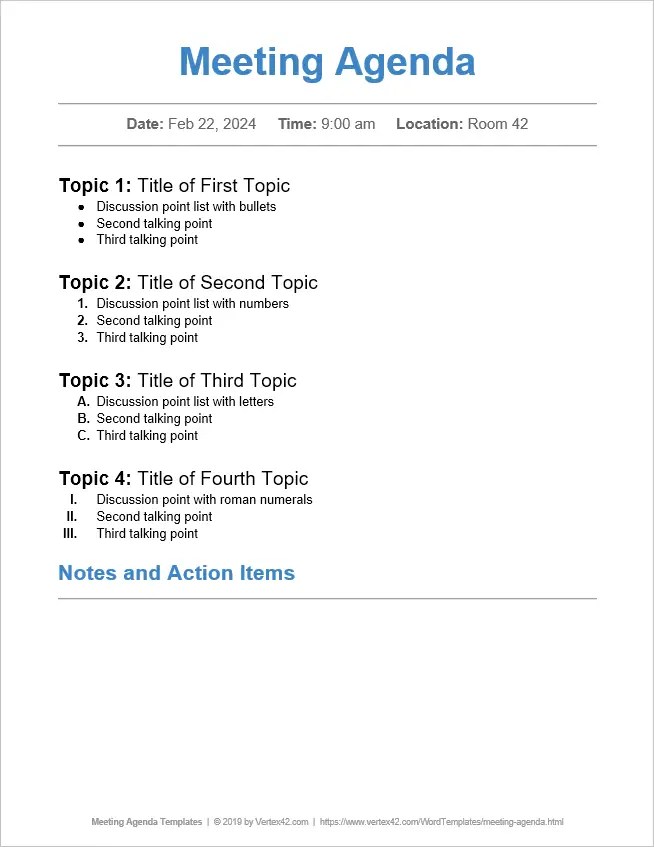 654×847 board meeting agenda template word from www.opensourcetext.org
  710×632 board meeting agenda templates from www.doctemplates.net
  1925×1000 board meeting agenda format template boardeffect from www.boardeffect.com
  1585×2048 format meeting agenda template docx photo meeting from wssufoundation.org
  1920×2475 creating board meeting agenda template uk ms word board from legaldbol.com
  1275×1650 board meeting agenda templates templatelab from templatelab.com
  585×580 board meeting agenda templates printable word excel formats from www.sampleformats.org
  2550×3300 board meeting agenda format templates allbusinesstemplatescom from www.allbusinesstemplates.com
  650×933 board meeting agenda templates progressive tips from www.wordtemplatesonline.net
  600×730 board meeting agenda template word documents from www.template.net
  1824×2584 board meeting agenda sample template edit fill sign handypdf from handypdf.com


Board Meeting Agenda Format :
Board Meeting Agenda Format was posted in December 3, 2025 at 1:06 am. If you wanna have it as yours, please click the Pictures and you will go to click right mouse then Save Image As and Click Save and download the Board Meeting Agenda Format Picture.. Don’t forget to share this picture with others via Facebook, Twitter, Pinterest or other social medias! we do hope you'll get inspired by SampleTemplates123... Thanks again! If you have any DMCA issues on this post, please contact us!
Related For Board Meeting Agenda Format

Nonprofit Board Meeting Agenda Temp
Nonprofit Board Meeting Agenda Template Running a successful nonprofitTrello Agenda Card Template
Here’s content about a Trello agenda card template, formatted