CRM Team Agenda Sample
CRM Team Agenda Sample
An effective CRM (Customer Relationship Management) team agenda is crucial for driving strategic alignment, fostering collaboration, and ensuring that efforts are focused on improving customer relationships and achieving business goals. This sample agenda provides a framework for regular CRM team meetings, focusing on key performance indicators, ongoing projects, new initiatives, and addressing challenges.
Meeting Basics
* **Meeting Frequency:** Weekly or bi-weekly (adjust based on team needs and project timelines). * **Meeting Duration:** 60-90 minutes. * **Attendees:** CRM Manager, CRM Analysts, CRM Specialists (e.g., marketing automation, sales enablement, customer support representatives), relevant stakeholders from sales, marketing, and customer service departments. * **Meeting Facilitator:** Rotate responsibility among team members to encourage participation and ownership. * **Preparation:** Agenda circulated at least 24 hours in advance, with required pre-reading materials attached. Team members are expected to come prepared to discuss relevant topics. * **Action Items:** Clearly defined action items with assigned owners and deadlines. Documented in meeting minutes and tracked for completion.
Sample Agenda Items
**1. Opening (5-10 minutes)** * **Welcome and Introductions (if needed):** Brief welcome from the meeting facilitator. If there are new attendees, provide brief introductions. * **Review of Previous Meeting Minutes and Action Items:** Quickly review minutes from the previous meeting. Status update on all assigned action items. If an action item is overdue, discuss the reason and agree on a revised completion date or alternative solution. **2. CRM Performance Review (20-30 minutes)** * **Key Performance Indicators (KPIs) Review:** * **Lead Generation and Conversion Rates:** Analyze lead generation performance, conversion rates at each stage of the sales funnel, and identify areas for improvement. For example, review metrics such as: * Number of leads generated (by source) * Lead-to-opportunity conversion rate * Opportunity-to-customer conversion rate * Average deal size * **Customer Acquisition Cost (CAC):** Review the cost of acquiring new customers. Discuss strategies to reduce CAC while maintaining or improving customer acquisition rates. * **Customer Retention Rate:** Analyze customer retention rates and identify factors influencing customer churn. Discuss strategies to improve customer loyalty and retention. Track metrics like: * Churn rate (overall and by segment) * Customer lifetime value (CLTV) * Renewal rates * **Customer Satisfaction (CSAT) and Net Promoter Score (NPS):** Review customer satisfaction scores and NPS feedback. Analyze trends and identify areas for improvement in customer service and product/service delivery. Discuss customer feedback and address any negative feedback or complaints. * **Marketing Campaign Performance:** Review the performance of recent marketing campaigns, including email marketing, social media campaigns, and other initiatives. Analyze campaign effectiveness and identify areas for optimization. Key metrics: * Open rates * Click-through rates * Conversion rates * Return on Investment (ROI) * **Data Quality Review:** Briefly discuss the overall health and accuracy of CRM data. Address any data quality issues and discuss strategies to improve data hygiene. * **Trend Analysis:** Identify any emerging trends or patterns in CRM data that could impact business strategy. **3. Project Updates (20-30 minutes)** * **Ongoing Project Status:** Provide updates on the progress of ongoing CRM projects, such as: * CRM system implementation or upgrades * Marketing automation initiatives * Sales process improvements * Customer service enhancements * **Milestone Review:** Review upcoming project milestones and identify any potential roadblocks or challenges. * **Resource Allocation:** Discuss resource allocation for ongoing projects and ensure that projects are adequately staffed. **4. New Initiatives and Ideas (10-15 minutes)** * **Brainstorming Session:** Dedicate time to brainstorm new initiatives and ideas for improving CRM effectiveness. * **New Technology Evaluation:** Evaluate new CRM technologies and features that could benefit the organization. * **Process Improvement Suggestions:** Discuss suggestions for improving CRM processes and workflows. **5. Challenges and Solutions (10-15 minutes)** * **Identify Challenges:** Identify any challenges or obstacles that are hindering CRM performance. * **Problem Solving:** Brainstorm potential solutions to address these challenges. * **Escalation:** Escalate any unresolved issues to the appropriate stakeholders. **6. Training and Development (Optional – Rotate Topics – 10-15 Minutes)** * **CRM System Training:** Provide training on new features or functionalities of the CRM system. * **Best Practices Sharing:** Share best practices for using the CRM system and improving CRM processes. * **Industry Updates:** Discuss relevant industry trends and developments in CRM. * **Soft Skills Training:** Incorporate training on relevant soft skills such as communication, collaboration, and customer service. **7. Action Items and Next Steps (5 minutes)** * **Review Action Items:** Summarize all action items assigned during the meeting, including owners and deadlines. * **Schedule Next Meeting:** Schedule the date and time for the next CRM team meeting. * **Meeting Adjournment:** Formally adjourn the meeting.
Example Topics for Deep Dive Sessions (Schedule Separately):
* **Deep Dive into Customer Segmentation:** Analyze customer data to identify key segments and develop targeted marketing and sales strategies. * **Marketing Automation Strategy Review:** Review the effectiveness of marketing automation workflows and identify areas for improvement. * **Sales Process Optimization:** Analyze the sales process and identify opportunities to improve efficiency and effectiveness. * **CRM Data Governance:** Discuss and implement policies and procedures for managing and maintaining the quality of CRM data. * **Competitive Analysis:** Analyze competitor CRM strategies and identify opportunities to differentiate the organization.
Key Considerations
* **Relevance:** Ensure that all agenda items are relevant to the team and contribute to the overall goals of the CRM strategy. * **Time Management:** Stick to the allocated time for each agenda item to ensure that the meeting stays on track. * **Engagement:** Encourage active participation from all team members to foster collaboration and innovation. * **Documentation:** Maintain detailed meeting minutes and track action items to ensure accountability. * **Flexibility:** Be flexible and willing to adjust the agenda as needed to address emerging issues or priorities. * **Continuous Improvement:** Regularly review the effectiveness of the CRM team meetings and make adjustments as needed to optimize their value. By consistently following a structured agenda and focusing on key performance indicators, the CRM team can effectively manage customer relationships, drive business growth, and achieve its strategic objectives. This sample agenda serves as a starting point and should be customized to meet the specific needs and priorities of the organization.
 600×730 team agenda templates sample format from www.template.net
 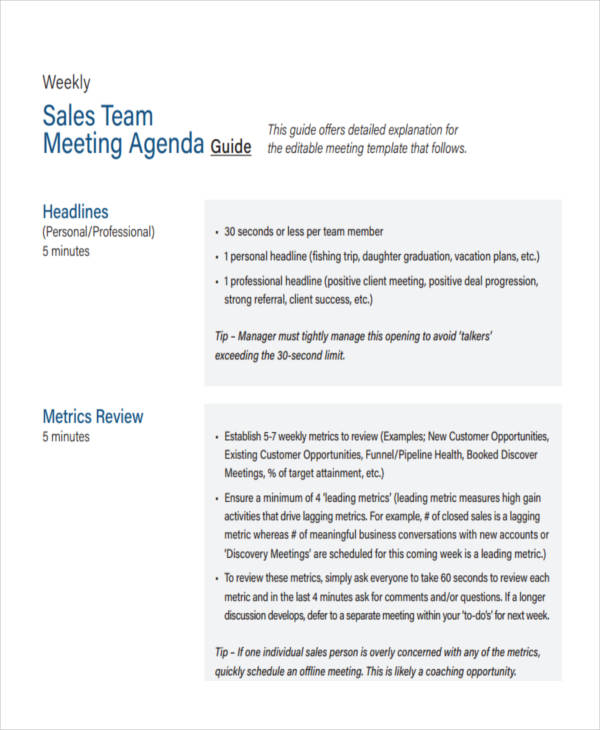 600×730 team agenda examples from www.examples.com
  768×1024 team meeting agenda template templates word excel from www.formsbirds.com
  820×1326 team building meeting agenda template invitation template ideas from howtostepmom.com


CRM Team Agenda Sample :
CRM Team Agenda Sample was posted in October 8, 2025 at 2:28 pm. If you wanna have it as yours, please click the Pictures and you will go to click right mouse then Save Image As and Click Save and download the CRM Team Agenda Sample Picture.. Don’t forget to share this picture with others via Facebook, Twitter, Pinterest or other social medias! we do hope you'll get inspired by SampleTemplates123... Thanks again! If you have any DMCA issues on this post, please contact us!