Real Estate Marketing Plan Template
Real Estate Marketing Plan Template: A Comprehensive Guide
A well-structured real estate marketing plan is the bedrock of success in a competitive industry. It provides a roadmap for attracting leads, converting prospects, and building a sustainable business. This template offers a framework to create a robust and effective marketing plan tailored to your specific goals and market.
I. Executive Summary
Begin with a concise overview of your marketing plan. This should encapsulate your overall marketing goals, target audience, key strategies, and anticipated outcomes. Think of it as an “elevator pitch” for your entire plan.
* **Mission Statement:** Briefly articulate your core values and what you aim to achieve through your real estate services. * **Marketing Objectives:** State your specific, measurable, achievable, relevant, and time-bound (SMART) marketing goals. Examples include: * Increase lead generation by X% within Y months. * Improve website traffic by Z% in the next quarter. * Increase brand awareness in target neighborhood A. * **Target Market Overview:** Summarize your ideal client profile (discussed in detail later). * **Key Strategies:** List the primary marketing strategies you will employ (e.g., social media marketing, content marketing, email marketing, direct mail). * **Budget Allocation:** Provide a high-level overview of how your marketing budget will be distributed across different activities. * **Expected Results:** Briefly outline the anticipated outcomes of your marketing efforts (e.g., increased sales volume, market share growth).
II. Market Analysis
A thorough understanding of your market is crucial. This section involves researching and analyzing various factors to identify opportunities and potential challenges.
* **Target Audience Definition:** Create detailed buyer personas. Consider demographics (age, income, family status), psychographics (values, interests, lifestyle), buying behavior, and pain points. Are you targeting first-time homebuyers, luxury buyers, investors, or empty nesters? * **Geographic Area Analysis:** Define the geographic area you will be targeting. Research local market trends, including: * Average home prices and price trends. * Inventory levels (buyer’s market vs. seller’s market). * Demographic changes and population growth. * Local economic conditions and employment rates. * School ratings and community amenities. * **Competitive Analysis:** Identify your key competitors in the market. Analyze their strengths, weaknesses, marketing strategies, pricing, and market share. This will help you differentiate your services and identify opportunities to gain a competitive edge. * **SWOT Analysis:** Conduct a SWOT (Strengths, Weaknesses, Opportunities, Threats) analysis to assess your internal capabilities and external factors impacting your business.
III. Marketing Objectives and Strategies
This section outlines the specific strategies you will use to achieve your marketing objectives. Each strategy should be tied to a measurable goal and include a detailed action plan.
* **Branding Strategy:** * Define your brand identity: What makes you unique? What values do you represent? * Develop your brand messaging: Create a consistent and compelling message that resonates with your target audience. * Design your visual identity: Choose a logo, color palette, and fonts that reflect your brand. * **Online Marketing:** * **Website Optimization:** Ensure your website is user-friendly, mobile-responsive, and optimized for search engines (SEO). Include high-quality photos, virtual tours, and detailed property listings. * **Search Engine Optimization (SEO):** Implement SEO strategies to improve your website’s ranking in search results. This includes keyword research, on-page optimization, link building, and local SEO. * **Social Media Marketing:** Develop a social media strategy to engage with your target audience on relevant platforms (e.g., Facebook, Instagram, LinkedIn). Create engaging content, run targeted ads, and monitor your social media presence. * **Content Marketing:** Create valuable and informative content (e.g., blog posts, articles, videos, infographics) to attract and engage your target audience. Focus on topics relevant to their needs and interests. * **Email Marketing:** Build an email list and send targeted email campaigns to nurture leads, promote listings, and provide valuable information. * **Paid Advertising (PPC):** Utilize paid advertising platforms like Google Ads to reach a wider audience and generate leads. * **Offline Marketing:** * **Direct Mail Marketing:** Send targeted direct mail pieces (e.g., postcards, flyers) to homeowners in your target area. * **Print Advertising:** Consider advertising in local newspapers, magazines, and real estate publications. * **Networking Events:** Attend local networking events to meet potential clients and build relationships. * **Open Houses:** Host well-organized and well-advertised open houses to showcase your listings. * **Community Involvement:** Participate in local community events to build brand awareness and goodwill.
IV. Budget and Resource Allocation
This section details how you will allocate your marketing budget and resources across different activities. Create a realistic budget based on your marketing goals and available resources.
* **Budget Breakdown:** Allocate specific amounts to each marketing activity (e.g., website development, SEO, social media advertising, print advertising, direct mail). * **Resource Allocation:** Identify the personnel and resources required to implement your marketing plan. This may include hiring freelancers, using marketing software, or outsourcing tasks. * **Tracking and Measurement:** Implement tracking mechanisms to monitor the performance of each marketing activity and measure its return on investment (ROI).
V. Implementation and Timeline
This section outlines the specific steps you will take to implement your marketing plan and provides a timeline for each activity. Break down your plan into manageable tasks and assign responsibilities.
* **Action Plan:** Create a detailed action plan for each marketing strategy, including specific tasks, deadlines, and responsible parties. * **Timeline:** Develop a timeline that outlines the key milestones and deadlines for your marketing plan. * **Contingency Planning:** Identify potential challenges and develop contingency plans to address them.
VI. Monitoring and Evaluation
Regularly monitor and evaluate the performance of your marketing plan to identify areas for improvement. Track key metrics and make adjustments as needed.
* **Key Performance Indicators (KPIs):** Identify the key metrics you will use to track the performance of your marketing plan. Examples include website traffic, lead generation, conversion rates, and sales volume. * **Reporting:** Create regular reports that summarize the performance of your marketing plan and highlight key insights. * **Analysis and Optimization:** Analyze your results and make adjustments to your marketing plan as needed to optimize its effectiveness. This is an iterative process, so be prepared to adapt and refine your strategies based on data and feedback. By following this comprehensive template, you can create a powerful real estate marketing plan that drives results and helps you achieve your business goals. Remember to regularly review and update your plan to reflect changing market conditions and emerging trends. Good luck!
 1125×730 printable real estate marketing plan template zillow premier agent from ikase.us
  1700×2200 real estate marketing plan examples from www.examples.com
 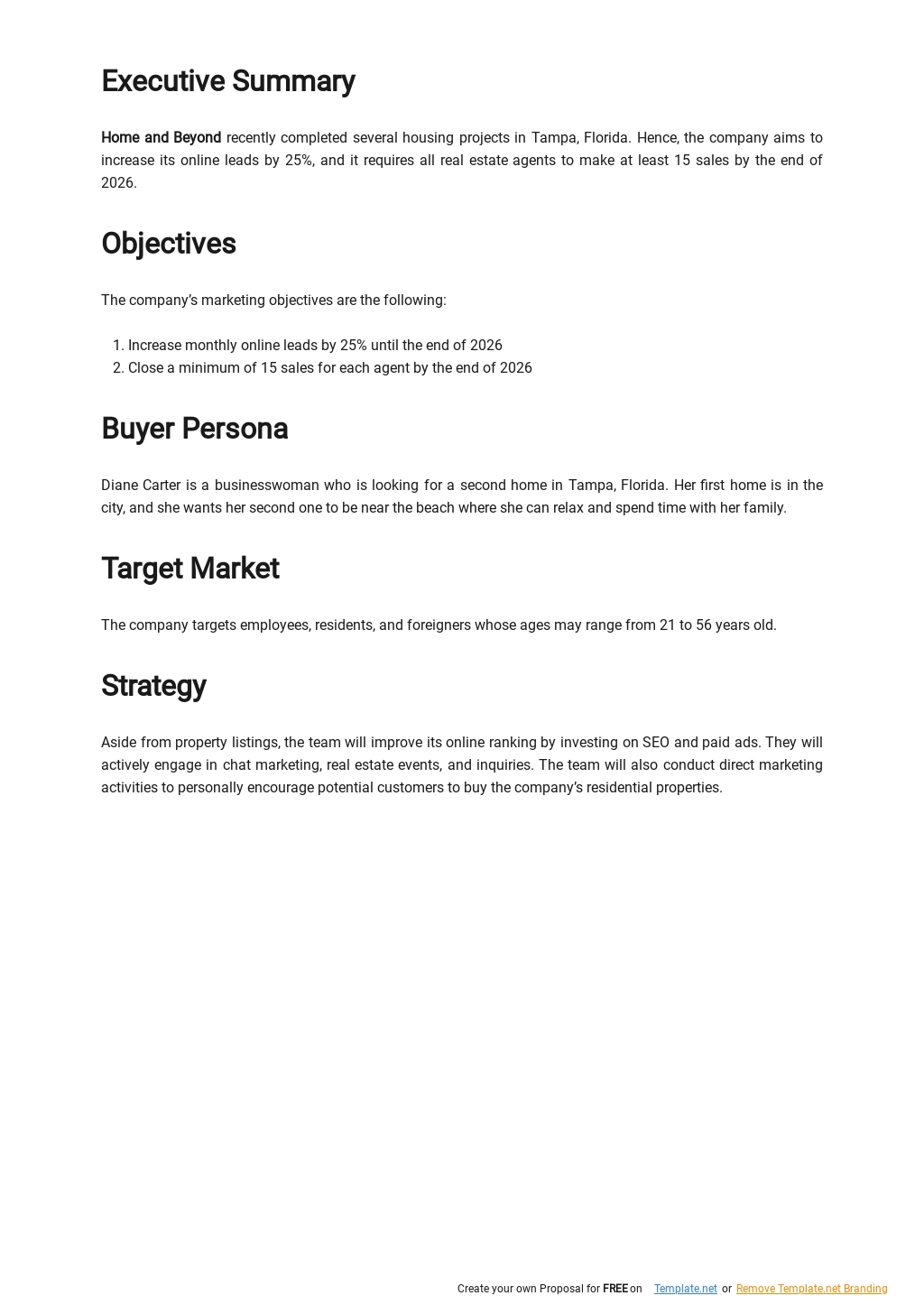 1024×1446 sample real estate marketing plan template google docs from www.template.net
  1056×816 real estate marketing plan template classles democracy from classlesdemocracy.blogspot.com
  1200×840 real estate marketing plan template word google docs apple pages from www.besttemplates.com
  900×600 real estate marketing plan template long term growth from theclose.com
  800×800 real estate marketing plans simple template from easyagentpro.com
  800×2000 real estate marketing blog blog archive jump real from reamark.com


Real Estate Marketing Plan Template :
Real Estate Marketing Plan Template was posted in December 8, 2025 at 4:46 pm. If you wanna have it as yours, please click the Pictures and you will go to click right mouse then Save Image As and Click Save and download the Real Estate Marketing Plan Template Picture.. Don’t forget to share this picture with others via Facebook, Twitter, Pinterest or other social medias! we do hope you'll get inspired by SampleTemplates123... Thanks again! If you have any DMCA issues on this post, please contact us!