PE Lesson Plan Template For Elementary Students
Elementary Physical Education Lesson Plan Template
This template provides a structured framework for creating effective and engaging physical education lessons for elementary school students. It focuses on developing fundamental motor skills, promoting physical activity, and fostering a positive attitude towards movement.
Lesson Information
- Teacher: [Your Name]
- Grade Level: [Specify Grade Level – e.g., 1st Grade, 4th Grade]
- Date: [Date of Lesson]
- Time: [Start and End Time of Lesson]
- Duration: [Total Lesson Time – e.g., 45 minutes]
- Number of Students: [Approximate Number of Students]
- Equipment: [List all equipment needed – e.g., Cones, Balls (specify type), Hoops, Jump Ropes, Mats, Music Player]
- Location: [Where will the lesson take place? – e.g., Gymnasium, Outdoor Field, Classroom]
Learning Objectives
Clearly state what students will be able to do by the end of the lesson. Use action verbs.
- Psychomotor Domain (Physical Skills):
- Example: “Students will be able to demonstrate the correct technique for throwing a softball using an overhand throw.”
- Example: “Students will be able to skip for a distance of 20 feet with proper form and coordination.”
- Cognitive Domain (Knowledge):
- Example: “Students will be able to identify the key muscle groups used during jumping jacks.”
- Example: “Students will be able to explain the importance of warming up before physical activity.”
- Affective Domain (Attitudes & Values):
- Example: “Students will demonstrate good sportsmanship by following rules and encouraging their peers.”
- Example: “Students will participate actively and enthusiastically in all activities.”
Remember to make your objectives SMART: Specific, Measurable, Achievable, Relevant, and Time-bound.
National/State Standards Alignment
Identify the relevant national or state physical education standards that the lesson addresses. This demonstrates the lesson’s alignment with curriculum requirements.
- Example: “NASPE Standard 1: Demonstrates competency in motor skills and movement patterns needed to perform a variety of physical activities.” (Specify sub-standards if applicable)
- Example: “[Your State] Standard 2: Understands movement concepts, principles, strategies, and tactics as they apply to the learning and performance of physical activities.”
List the specific standard code and a brief description of how the lesson addresses that standard.
Lesson Procedure
Provide a detailed, step-by-step description of the lesson’s activities. Include estimated timeframes for each activity to help manage the lesson effectively.
1. Introduction/Warm-up (5-10 minutes)
- Description: Engage students and prepare them physically and mentally for the lesson.
- Activity:
- Example: “Begin with a dynamic stretching routine: arm circles (forward and backward), leg swings, torso twists. Follow with a light jog around the perimeter of the gym.”
- Example: “Play a quick game of ‘Simon Says’ incorporating locomotor skills like hopping, skipping, and jumping.”
- Teaching Points:
- Emphasize proper form and technique during stretches.
- Encourage students to listen carefully and follow directions.
2. Activity 1: Skill Development (15-20 minutes)
- Description: Focus on teaching or reinforcing a specific motor skill.
- Activity:
- Example: “Teach the proper technique for throwing a beanbag. Divide students into pairs. One student throws, the other catches. Rotate roles after 5 throws. Focus on stepping with the opposite foot, rotating the torso, and following through.”
- Example: “Introduce jump rope skills. Start with practicing the ‘bunny hop’ over the rope, then progress to single jumps. Provide modifications for students who are struggling.”
- Teaching Points:
- Provide clear and concise instructions.
- Demonstrate the skill correctly.
- Offer individualized feedback and corrections.
- Modifications/Differentiation:
- Easier: Provide larger targets, use softer balls, allow students to stand closer to the target.
- More Challenging: Increase the distance, use smaller targets, introduce more complex movements.
3. Activity 2: Game/Application (15-20 minutes)
- Description: Provide an opportunity for students to apply the skills they learned in a fun and engaging game.
- Activity:
- Example: “Play ‘Beanbag Toss.’ Set up hula hoops as targets at varying distances. Students take turns throwing beanbags into the hoops. Award points based on the distance of the hoop.”
- Example: “Play ‘Jump Rope Relays.’ Divide students into teams. Each team member must jump rope a certain number of times before the next team member can go.”
- Teaching Points:
- Reinforce the importance of teamwork and cooperation.
- Emphasize fair play and following the rules.
- Modifications/Differentiation:
- Adjust the rules of the game to make it more or less challenging.
- Allow students to modify the activity to meet their individual needs and abilities.
4. Cool-down/Closure (5 minutes)
- Description: Help students gradually decrease their heart rate and reflect on what they learned.
- Activity:
- Example: “Lead students through a series of static stretches, holding each stretch for 20-30 seconds. Focus on the muscles used during the lesson.”
- Example: “Ask students to share one thing they learned during the lesson or one thing they enjoyed. Review the key teaching points.”
- Teaching Points:
- Explain the importance of cooling down to prevent muscle soreness.
- Encourage students to reflect on their performance and identify areas for improvement.
Assessment
Describe how you will assess student learning and progress. This could include observations, checklists, or informal questioning.
- Observation: Observe students’ performance during the activities and note their ability to demonstrate the target skills.
- Checklist: Use a checklist to assess students’ proficiency in specific skills, such as throwing technique or jump rope skills.
- Informal Questioning: Ask students questions about the key concepts and principles taught in the lesson.
- Self-Assessment: Have students reflect on their own performance and identify areas where they can improve.
Provide specific examples of what you will be looking for in student performance.
Safety Considerations
Identify potential safety hazards and outline precautions to minimize the risk of injury.
- Space: Ensure adequate space for students to move safely without bumping into each other.
- Equipment: Check equipment for damage and ensure it is properly maintained.
- Supervision: Provide close supervision of students, especially during games and activities that involve running or jumping.
- Hydration: Remind students to stay hydrated by drinking water before, during, and after the lesson.
- Injuries: Be prepared to handle minor injuries and have a plan for dealing with more serious injuries.
Differentiation/Modifications
Explain how you will differentiate instruction to meet the needs of all learners, including students with disabilities, English language learners, and students who are gifted and talented.
- Provide varied levels of challenge: Offer modifications and adaptations to the activities to make them more or less challenging.
- Use visual aids: Use visual aids, such as diagrams and videos, to support learning.
- Provide individual assistance: Provide individual assistance to students who are struggling.
- Offer choices: Allow students to choose from a variety of activities to meet their individual needs and interests.
Refer to the “Modifications/Differentiation” sections within each activity for specific examples.
 585×555 elementary pe lesson plan template simple template design from pictimilitude.com
  1899×1468 elementary pe lesson plans pe lesson plan template elegant elementary from daisyblake.com
 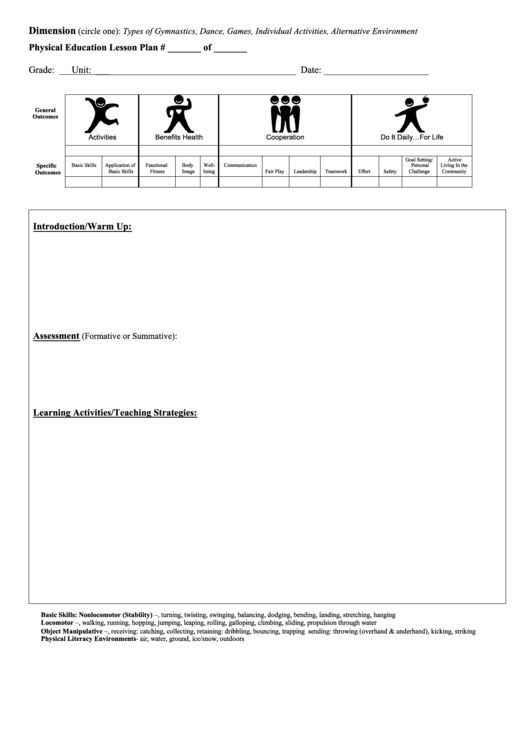 530×749 lesson plan template pe printable from www.formsbank.com
  988×1200 elementary pe lesson plans include lesson plan template from daisyblake.com
  256×336 pe lesson plan template sampletemplatess sampletemplatess from www.sampletemplatess.com



PE Lesson Plan Template For Elementary Students :
PE Lesson Plan Template For Elementary Students was posted in September 2, 2025 at 9:08 pm. If you wanna have it as yours, please click the Pictures and you will go to click right mouse then Save Image As and Click Save and download the PE Lesson Plan Template For Elementary Students Picture.. Don’t forget to share this picture with others via Facebook, Twitter, Pinterest or other social medias! we do hope you'll get inspired by SampleTemplates123... Thanks again! If you have any DMCA issues on this post, please contact us!